Monday, June 14, 2010

How the Talmud can be a road map to peace

Israelis and Palestinians could learn from the ancient rabbis


By Daniel Reisel, November 19, 2009

Could Bibi Netanyhau and Mahmoud Abbas (right), with Barack Obama at the UN in September, benefit from a Talmud class?
‘Two are holding a garment,” begins the Talmud in tractate Baba Metzia. Each claims they found it. “One says, kulo sheli — all of it belongs to me. The other says, kulo sheli — all of it belongs to me.”

The first chapter of Baba Metzia presents a well-known scenario. Two people claim an object. The nature of the dispute is such that the original ownership cannot be established. Both claims are emotional, exclusive and absolute.

Convene a court, says the Talmud, and let each party swear an oath. Following the swearing of the oath, the garment should be sold and the proceeds from the sale divided equally. But what is the content of the oath? One might have expected the court to require each side to swear that they own the whole garment. After all, that is what they have already stated. The Talmud rejects this as it would mean that at least one of them would utter a shvuah sheker, a false oath.

On the other hand, one might have expected each party, in the spirit of compromise, to swear that they own half the garment, the half currently in their possession. The Talmud rejects this solution too, on the grounds of mara lei lediburei , it would render their earlier statement a lie. Instead, the Talmud offers a striking formulation. Each party should swear they own lo pachot mi-chetziah, not less than half of it.

What is the difference between “half” and “not less than half”? In terms of the final outcome, the two formulations are virtually identical. In the end, both accept that the value of the garment will be divided equally between them. Emotionally, however, there is a world of difference. The Talmud’s solution allows each side to start the journey down from their absolute positions without denying their narrative. This enables them to keep their integrity and enter into dialogue without feeling defeated.

The formulation of “not less than half” is effective because it creates an imaginary space. It is imaginary because it is, in effect, the same “space” used twice. Both sides feel they have been granted more than their actual share. And they have: their story has been heard. The beauty of the Talmud’s move is that it realises that the dispute is not merely about the garment; it is about everything the disputed object represents. It is about everything that has been invested in the idea of the whole, and thus the pain of losing it.

The resolution of conflict doesn’t mean the end of the dialogue. The two sides will always inhabit the imaginary room together. Their dream of the whole will never leave them and this is something they will always have in common.

As suggested by Jeremy Haber in the Magnes Zionist blog, the Talmud’s approach could provide a precedent for solving the Arab-Israeli conflict. Two nations claim a land. One says, all of it belongs to me. The other says, all of it belongs to me. Each has their story. Each holds on to their side, unwilling to let go.

The Talmud teaches that the first task of an external arbiter is to engage the parties in unconditional dialogue. Open, respectful conversation is more likely to produce results than delegitimisation and denial. Humility cannot be enforced through humiliation. On the contrary, for it to work, such a process must accept the historical and religious ties of each side to the land. Neither side should be expected to give up their emotional connection to the whole. Neither side should be required to utter falsehoods.

At the same time, for the dialogue to be effective, each party has to start the journey down from their absolute positions. Each side needs to accept that although they have a just claim to the whole, reality demands a fair solution. Rather than requiring each party to renounce their narrative, the Talmud counsels each side to state unequivocally: “I don’t own less than half of this land.” Only then can the painstaking process of division commence.

We need leaders, both political and religious, who have the courage to lead us on this complex journey. If it proves too costly for them, as it did for Yitzhak Rabin, then other actors on the ground need to create the conditions for dialogue.

In this process, we need to take more pride in our heritage, not less. We should never be required to give up the dream of the whole. Yet we must realise that to want the dream exclusively for ourselves will transform it into our worst nightmare. We need to hold fast to our side of the garment. But we need to realise that ours is the many times promised land. There are others who hold fast to it as well. And it is time we made space for their narrative, too.

In 1956, eight years after the miracle of Israel’s founding, David Ben Gurion said: “In Israel, anyone who doesn’t believe in miracles is not a realist.” In the arduous task of securing Israel’s future, we need to preserve our faith in our ability to work miracles. For this, the Talmud offers us a timeless template.

Daniel Reisel is education chair of the Jewish human rights organisation René Cassin

Wednesday, June 9, 2010

The Palestinian version of Brit Shalom

There are a few palestinian intellectuals who have carried out the same analysis as I did, and have reached the same conclusions . This is very encouraging. It means that a mouvement can be created by Arabs and Jews together. The simple fact of its very existence could have a profound impact in establishing an atmosphere of trust between the two sides.

Here is an article of Baruch Kimmerling from Brit Shalom website, originally published in Haaretz (emphasis mine):

The Palestinian version of Brit Shalom

For some time now, a group of Palestinian intellectuals, including Assad Ganem, MK Azmi Bishara, Adel Mena'a and Nadim Ruhna, has been trying to change Palestinian national strategic goals.The members of the group are convinced that instead of working to establish an independent Palestinian state alongside Israel, and to turn Israel into a state for all its citizens, the Palestinians should aspire to establish a Palestinian-Jewish binational state.

This state would arise within the borders of mandatory Palestine, and realize the national hopes and needs of both the Jewish and Palestinian peoples.

The idea is not only a profound conceptual revolution and a new trend in Palestinian political thought, it also requires much political and intellectual courage on the part of those suggesting it.

Although some might attribute the idea to a hidden manipulative motive -just another, more sophisticated way to destroy the "Zionist entity" - the efforts appear to be a genuine attempt to find political solutions to real problems that seem to have no reasonable solution acceptable to both sides, while maintaining a consistent moral position respecting the universality of human rights.

These problems have been shown to be all the more salient and thorny with the first serious attempt by both sides to find an answer to the Jewish-Palestinian conflict: the Oslo agreements, the mutual declaration of recognition of the other side's right to exist as a legitimate political entity.

Oslo was also accompanied by far-reaching territorial concessions by
both Jews and Palestinians, in an attempt to create some kind of
"separation" between the two peoples. But on the ideological-emotional plane, there is an enormous collective difficulty on both sides in conceding essential parts of the homeland, sanctified both religiously and secularly. And on the practical level (the physical and political), there are real difficulties in implementing the separation, because Eretz Israel-Palestine is not only a small piece of land, it is also very poor in resources relative to the number of people who are expected to utilize them.

Furthermore, those areas suitable for settlement include joint material assets (water sources and reservoirs, sewage, beaches, green areas, airspace, etc.), which in effect cannot be separated. And even if a fair division of the resources could be devised, the existence of settlements in the territories intended for the Palestinian state, and the existence of a Palestinian-Arab minority inside Israel - which does not enjoy full equality as citizens - further complicates the ideal of a "pure" separation.

Even more serious for Palestinian intellectuals is that, were a Palestinian state to be established, it would be a very sorry one, split territorially into two geographical parts, with Israel controlling passage between the truncated country. It would be dependent on Israel for everything.

Another area of deep disappointment among most Arab intellectuals - at least those not employed by the Palestinian Authority - is the authoritarian and manifestly undemocratic nature of the Palestinian Authority. This was not what they imagined the Palestinian state would be. Neither do they expect the Palestinian government to undergo
democratization in the foreseeable future. They view with growing concern the increasing strength of the Islamic elements within the Palestinian society.

Indeed, on both sides of the equation, just as there are those who
regard the entire land as exclusively theirs (and those ready for its
division are defeatist, unpatriotic, immoral or blasphemously
sacreligious), so are there those who regard redividing the country a
pragmatic neccessity resulting from a given historical reality.

What the Palestinian intellectuals want is the de jure recognition of a situation that in any case exists de facto, with all the implications that may be involved concerning the attainment of equal rights for the two nations in a binational reality.

If it is impossible to separate the two nations, and impossible to divide the land, which each nation considers entirely its own, then perhaps they can be fused.

Azmi Bishara has presented a fascinating conceptual innovation (which his critics did not understand at all); he wants to separate national territorial affiliation from citizenship of a country.

Thus, even without territorial division, the two nations could each belong to its own exclusive country, to vote and be elected within it and to be subject to its government, and take pride in its national symbols.

This suggestion is a fascinating intellectual attempt to square the circle. The idea is that within the same borders and the same territorial receptacle, two political and symbolic entities would coexist.

The suggestion should not be dismissed summarily by routine thinking; it should be discussed and debated as part of the public dialogue between and among Palestinians and Israelis if only because as a logical model, it can help us develop new channels of thinking.

For much of the Jewish public in Israel, dropping the idea of binationalism into the public debate is perceived as more threatening than dropping the Islamic nuclear bomb. But because of the deadlock in our relations with the Palestinians, and the profound moral ramifications inherent to the idea of binationalism, the concept threatens the existing collective identity, undermining it on both sides.

The ideological opposition to the binational solution is perhaps the only common denominator which can still create a unified front among the varies factions in Jewish society.

In 1925, the Jews in Israel were a tiny majority of the population and Zionism was not perceived as a movement capable of drawing masses of Jewry to come to settle in Eretz Israel. At the time, it seemed that the presence of Jews in Eretz Israel would be dependent on the good will of the Arab population, while the binational concept suggested by the Brit Shalom [Peace Alliance] movement unified the entire Jewish population against it. Now, after Israel has become a regional power it is unlikely that the Palestinian version of Brit Shalom will any more successful that its Jewish counterpart - not even among Palestinians.

However, the very existence of the group is an important political and cultural development, because its appearance may yet contribute to the revival of the political and intellectual dialogue, which otherwise is dying out day by day.

Baruch Kimmerling
© copyright 2000 Ha'aretz

طريقة مختلفة للتفكير في حل الدولتين


طريقة مختلفة للتفكير في حل الدولتين
السبت فبراير 13 2010 - جيروم سيغال


اليوم، وعلى الأقل من الناحية اللفظية فإن منظمة التحرير الفلسطينية واسرائيل متفقتان على أن النتجة المركزية لمحادثات الوضع الدائم يجب أن تكون دولة فلسطينية ستتواجد بجوار دولة اسرائيل. وبشكل عام، ولكن بصورة خاصة للاسرائيليين، فان فهم كيفية تفاعل هاتين الدولتين هو واحد من الأمور المتعلقة بالفصل الكامل، "نحن هنا وهم هناك".

بالنسبة للاسرائيليين فالفصل المطلق يتمثل في الجدار أو "سياج الفصل" حتى وإن كان المكان الدقيق للحدود الدائمة بين الدولتين لم يتحدد بعد. وينعكس ذلك أكثر في تصميم اسرائيل على أن أيا من اللاجئين لن يعود، وبالتأكيد ليس من خلال "حق العودة". ومن الجانب الفلسطيني فرؤية الفصل الكامل منتشرة على نطاق واسع. ويتم التعبير عنها من خلال التصميم الفلسطيني على انه عدا عن تبادل أراض هامشي، يجب إخلاء كل المستوطنات الاسرائيلية من كل الأراضي التي ستصبح دولة فلسطينية ، والرغبة في حدود واضحة ومستقيمة.

والملحقات مع مع مفهوم الفصل المطلق في حل الدولتين قوية الى الحد الذي تؤدي فيه احيانا الى الخلط بين فكرة حل الدولتين وفكرة حل الوطنين. وعلى سبيل المثال ففي مشروع كلينتون وجدنا الجملة "دولة جديدة لفلسطين على وشك آن تقام كوطن للشعب الفلسطيني، كما أن اسرائيل أقيمت كوطن للشعب اليهودي". وبالمثل ففي مبادرة جنيف نجد حل الدولتين متداخلا مع فكرة حل الوطنين:"يعترف الطرفان بفلسطين واسرائيل كوطنين للشعبين علىالتوالي".

وهذا نوع من الخلط. فمفهوم "الوطن" يختلف تماما عن مفهوم "الدولة". الدول بنى سياسية، وتتم اقامتها في لحظات من الزمن نتيجة لأفعال إرادية ناجمة عن عملية بشرية لصنع القرار. لكن الوطن شيء مختلف. فمنطقة جغرافية ما هي وطن لشعب، ليس بسبب قرار سياسي، ولكن بفعل تاريخ ذلك الشعب وهويته. وهي منطقة هاجر اليها الشعب او ازدهر وتلعب دورا مركزيا في فهمهم الخاص لأنفسهم. وحتى نطلق على شيء ما صفة الوطن يعني بأن هذا الشيء مهم للذات الجماعية ولكيفية فهم الانسان لنفسه من خلال علاقته بتاريخ الشعب الذي ينتمي اليه. وهكذا بالنسبة للفلسطينيين بينما قد تكرس اتفاقية سلام الضفة الغربية وقطاع غزة كأرض للدولة الفلسطينية، فان هذه الاتفاقية لا يمكن ان تلغي حقيقة ان كل فلسطين التاريخية هي وطن للشعب الفلسطيني. وبالمثل، فليس هناك قرار سياسي او وثيقة يمكنها تغيير حقيقة ان الوطن التاريخي لليهود لا يتطابق بالكامل مع حدود اسرائيل . وليس الانسان مضطرا لقبول مرجعية التوراة اليهودية ليدرك اهمية حقيقة انه في هذا النص القديم الذي يعود الى ما قبل ٢،٥٠٠ سنة، يُقال لليهود كيف أن ابراهيم واسحق ويعقوب عاشوا في المنطقةالتي تعرف الآن بنابلس وكيف دفنوا في الخليل. وبالفعل فهذا القصة اليهودية القديمة،التي شكلت الفهم الذاتي لليهود خلال آلاف السنين لا تعطي كبير أهمية للسهل الساحلي الذي يعيش فيه معظم الاسرائيليين حاليا.

وحقيقة ان اليهود والفلسطينيين سواء من حيث التاريخ أو الانتماء يعتبرون نفس المنطقة وطنا لهم، لا تقدم جوابا حول علاقة كل من الدولتين بالأخرى. ومن الممكن تماما القول بأن في داخل الوطن المشترك ستقام دولتان ، منفصلتان تماما. والمشكلة في ذلك هي انذلك يتناقض مع حقيقة أنه بالنسبة للشعبين فالوطن هو اكبر اتساعا من الحدود المقترحة لكل دولة، وقد اثبت الانفصال الكامل بصورة خاصة أن من الصعب التفاوض بشأنه. واذا تم التفاوض حوله فليس فيه استقرار. وعلى سبيل المثال:

* التنفيذ: في حين أن المفاوضين الاسرائيليين كانوا راغبين في الموافقة على اخلاء معظم المستوطنات في الضفة الغربية وبإمكان المرء أن يتفاءل بأن الاتفاق على حدود دولة فلسطينية يمكن التوصل اليه، فهناك شكوك قوية بشأن تنفيذ اتفاق كهذا. فهل ستكون لدى أي حكومة اسرائيلية القدرة على تنفيذ إخلاء ٧٥،٠٠٠ مستوطن من المناطق الوسطى في الضفة الغربية؟ وماذا لو أن نسبة مئوية عالية من المستوطنين كانوا مستعدين لمقاومة الإخلاء؟ هل ستقاتل اسرائيل حقا افرادا من شعبها من أجل الوفاء بالتزاماتها بموجب الاتفاق؟

* الديمومة: اذا قبل المفاوضون الفلسطينيون (منظمة التحرير الفلسطينية) اتفاقا لا ينص على حق العودة للاجئين، فسيتعرضون لفقدان الشرعية. واذا ظهرت دولة فلسطينية الى حيز الوجود على هذا الأساس، فهناك احتمال كبير بأن حماس أو منظمة تالية ستصل للسلطة بفوزها في الانتخابات الأولى أو الثانية في تلك الدولة. واذا حدث ذلك فهل يمكن لاتفاق سلام أن يستمر؟

* القابلية للتفاوض: المضاعفات السياسية للتخلي عن حقوق اللاجئين مفهومة بالنسبة لقيادة منظمة التحرير الفلسطينية. ونتيجة لذلك فقد سعوا في المفاوضات السابقة للحصول من الاسرائيليين على بعض الاستعداد للسماح بعودة عدد معقول من اللاجئين وعلى قبول من حيث المبدأ للحق العام في العودة. ومن جهة أخرى فالموقف الاسرائيلي حول الحدود اصبح واعدا اكثر بينما بات التشدد في قضية اللاجئين أكبر. واليوم لا يوجد اي استعداد للسماح بعودة اي من اللاجئين. وهكذا فان مفهوم الفصل المطلق في اطار حل الدولتين يواجه مشكلات كبيرة فيما يتعلق بامكانية التفاوض.

ومع الأخذ في الاعتبار أن حل الدولتين في اطار نموذج الفصل المطلق لا توجد احتمالات كبيرة للتفاوض بشأنه أو تطبيقه أو استمراريته، فمن الجدير بنا تفحص ما اذا كان هناك حل بديل قابل للتطبيق لنموذج حل الدولتين. ما الذي سيبدو عليه حل الدولتين اذا تبنينا بدلا من الدخول في تعقيدات مفهوم الوطن المشترك أن نتعامل مع الواقع؟ هنا سنناقش كيف سيعمل نموذج "وطن مشترك" لحل الدولتين:

١- أولا وقبل كل شيء، اتفاقية سلام بدلا من التركيز على تطبيق حل الدولتين، سيتمحور حول الاعتراف المتبادل بأن كل الأراضي الواقعة بين نهر الأردن والبحر المتوسط هي وطن مشترك للشعبين. والطرفان المفاوضان (منظمة التحرير الفلسطينية وحكومة اسرائيل) سيتعهدان ببذل قصارى جهودهما من أجل احترام حقيقة هذا الوطن المشترك. وبينما سيسلمان بأن الطبيعة الراهنة للعلاقات بين الشعبين ربما لا تسمح بالتنفيذ الكامل، فسيؤكدان على انه، من حيث المبدأ، فإن مواطني الشعبين، لهم الحق في العيش حيثما أرادوا داخل الوطن المشترك.

٢- ثم وبعد قبول أن هناك وطنا واحدا وانه يجب التشارك فيه، سيوافقان انه في الوقت الحاضر وربما حتى اشعار آخر في المستقبل، فالحل العملي هو تقسيم الوطن الى دولتين سياديتين هما بتعبير قرار التقسيم رقم ١٨١ الصادر عن الأمم المتحدة "واحدة عربية والثانية يهودية". وربما تنص المعاهدة على ان من الممكن مع مرور الزمن ان يتطور حل الدولتين الى احتمالات مختلفة بينها كونفيدرالية بين الدولتين او دولة فيدرالية واحدة لهل اقليمان او حتى دولة موحدة يتساوى جميع مواطنيها في الحقوق. وقد يتفق الطرفان على انهما سيجتمعان بشكل دوري مرة كل ١٠ أو ١٥ سنة لبحث احتمالات كهذه.، لكن مثل هذه التغييرات تتطلب موافقة الدولتين معا.

٣- وكرمز على وحدانية الوطن فان البلدة القديمة من القدس ستكون خارج السيادة السياسية. وربما تكون ملكا للشعبين، مع وضع الحرم القدسي تحت اشراف فلسطيني وحائط المبكى تحت ادارة اسرائيلية. ومن الممكن بهدف تأكيد وحدة الجذور للديانات الاسلامية واليهودية والمسيحية انه بالنسبة للبلدة القديمة فالسيادة عليها لله وحده.

٤- فيما يتعلق باليهود الراغبين في العيش في الضفة الغربية والفلسطينيين (سواء اللاجئين أو غيرهم) الذين يريدون الحياة في اسرائيل يجب التأكيد على انه من خلال نموذج حل الدولتين فلكل دولة صلاحيتها المطلقة بشأن إدخال غير المواطنين إلى أراضيها السيادية. وعلى هذاالأساس فان حل الدولتين يمكن ان يتضمن عددا من البرامج التجريبية خلال فترة تنفيذ مطولة. وهكذا، وعلى سبيل المثال، ربما يكون ممكنا قبول مستوطنة مثل ارييل مع الموافقة على أن الأرض المقامة عليها تقع ضمن السيادة الفلسطينية ويجب ان يكون لدى الجانبين برنامج تجريبي تتطابق فيه ارييل مع منطقة داخل اسرائيل تكون موطنا تقليديا للاجئين الفلسطينيين، وكما ان مواطنين اسرائيليين سيسمح لهم بمواصلة البقاء في ارييل فسيسمح بالمثل للاجئين بالعودة للعيش في بلدة جديدة داخل اسرائيل على ان ترتبط مع الدولة الفلسطينية بطرق خاصة محددة. ويمكن ان يطبق هذا الترتيب على اساس تجريبي، وسيمثل الأمل بإيجاد وسائل لتطبيق أوسع نطاقا للحق في الحياة في اي مكان داخل الوطن المشترك. واذا ثبت بعد عدة سنوات ان هذه افكرة صعبة التنفيذ فسيتم اخلاء ارييل والمنطقة المطابقة لها داخل اسرائيل. ومع ذلك فحتى هذا الترتيب لن يكون دائما. فبعد عقد من السلام والتهدئة يظهر خلاله جيل جديد يمكن مجددا بحث امكانية هذه الفكرة او غيرها لاعطاء تعبير ذي معنى لوحدانية الوطن.

٥- بخصوص عدد من اكثر المشكلات الأمنية ازعاجا والتي تقلق الاسرائيليين (مثلا كيف يمكنهم التأكد من أإن انهاء الاحتلال لن يعني سقوط صواريخ من الضفة الغربية على مطار اللد) يجب ايجاد حلول تحترم السيادة الفلسطينية والكرامة المتساوية للدولتين. احد الاحتمالات في اطار نموذج الوطن المشترك قد يتمثل في قوة أمنية مشتركة لها وجود على طول الخطوط الخارجية للوطن الواحد. وهكذا فبدلا من وجود قوات اسرائيلية على الحدود مع الاردن كما تطلب اسرائيل يمكن ان تتواجد قوة مشتركة على حدود لبنان ايضا وحدود سوريا ومصر. ومن جديد يمكن ان تعتبر هذه القوة تجريبية واذا فشلت فان ذلك سيؤدي الى ترسخ الفصل الشامل بين الدولتين مع بقاء الردع كعامل رئيس بعد اهتزاز الاستقرار ، الا آن التطلع سيظل نحو التعاون.

٦- من الناحية الاقتصادية فتوجه الوطن المشترك قد يتابع آهداف قرار التقسيم للعام ١٩٤٧ رقم ١٨١ المنصوص عليها في بند "الوحدة الاقتصادية والنقل البري " بما في ذلك الوحدة الجمركية، والعملة الموحدة التي ستحل محل الشيكل الاسرائيلي، والقطارات المشتركة ، والموانىء الموحدة والمطارات، بالاضافة الى "حرية الترانزيت والزيارات لمواطني الدولتين". وكا ورد في القرار ١٨١، فهذه الحريات ستخضع للاعتبارات الأمنية، ولكن في ظل السلام الحقيقي، ستكون الدولتان مفتوحتين للشعبين.

٧- وأخيرا وهنا أمر في غاية الأهمية، فان فكرة الوطن المشترك ستؤكد على التعليم الذي سيعزز القدرة المستقبلية للشعبين للتشارك الفعال في نفس الأرض. وسيطلب ذلك رغبة من المجتمعين في الانفتاح على معرفة كيف يفهم الطرف الآخر نفسه وتاريخ الصراع. ولن يحاول اي طرف السيطرة على مناهج الطرف الآخر الدراسية، لكن الجانبين سيوافقان على السماح لشبابهما بالتعلم مباشرة عن الآخر ما يتعلق بالروايتين المختلفتين للطرفين.

وفي الوقت الحاضر، فان العلاقات بين الشعبين بعيدة للغاية عما هو مطلوب لتحقيق ما وصفته. ولكن قد يكون من الخطأ استبعاد هذا الطرح على ان ساذج. ما قدمته هنا هو تطلع مثالي يمكن للطرفين التعهد بتبنيه. واذا اعتقدنا ان مفاوضات السلام تاريخية، فعلينا الاعتراف بأن العلاقات بين الدلتين ستشهد صعودا وهبوطا. وحتى لو تقرر في البداية العمل في اطار خطوط الفصل المطلق، فان توجهات الوطن المشترك تعبر عن نوايا لتحقيق مستقبل يمكن للجانبين آن يتشاركا بصدق في وطنهما المشترك.

---------------------------------

* جيروم سيغال هو باحث في معهد جامعة ميريلاند للفلسفة والسياسة العامة ومؤلف كتاب " إقامة الدولة الفلسطينية: استراتيجية للسلام" الذي صدر عام ١٩٨٨.

Tuesday, June 8, 2010

Israël Etat juif?

Philippe, un visiteur du blog, m'a envoyé le message suivant :
"A propos d'israel comme Etat juif

Bonjour,

je découvre votre blog avec beaucoup d'intérêt. Je voudrais vous poser une question: je comprends bien l'importance pour les juifs, de part de le monde, de préserver le judaïsme de l'Etat d'Israël et je comprends également l'inquiétude des Israéliens devant la menace que fait peser les évolutions démographique sur cet aspect. Bien qu'étant non juif, la majorité de mes amis le sont: je sais l'importance d'Israël pour eux et je ne peux envisager un instant qu'Israël ne reste pas, ad vitam eaternam, la patrie du peuple juif.
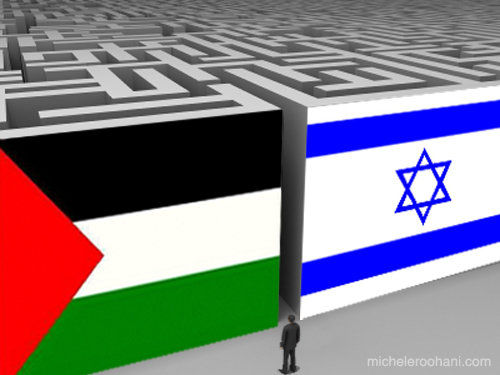
LabyrintheDans le même temps, je me pose une question "philosophique". Comment accepter de construire un Etat fondé sur une ethnie/une religion (le judaisme a ceci de particulier que la religion et l'ethnie se confondent - ce qui est probablement pour beaucoup dans les persécutions qu'à connu ce peuple) alors même que c'est cette idée même de construire un Etat fondé sur la "pureté" ethnique qui est à l'origine de la pire barbarie dont le peuple juif a souffert? N'y a t-il pas là une contradiction fondamentale?

Je n'ai pas de réponse évidente à cette question et je serai heureux de lire votre point de vue.

Merci d'avance."
J'ai répondu longuement, mais ma réponse est restée sans suite. J'aurai pu me débarrasser de la question en quelques mots: les Juifs (écrit avec une majuscule) sont un peuple historique, et non une ethnie et/ou une religion, donc ils un droit à un Etat selon le principe du droit à l'autodétermination des peuples.

Mais il est clair que pour un Français républicain - comme pour le citoyen de tout autre Etat-Nation - les citoyens juifs de son pays sont une part intégrale de sa nation, et ne peuvent donc être compris que comme une des ethnies ou religions qui la compose, et non comme une nation à part entière. Il n'y a plus guère que des antisémites pour considérer les juifs comme un vrai peuple!
J'ai donc développé ma réponse pour apporter les éclaircissements conceptuels qui s'imposent. Je la publie ici:

Le problème vient de la nature de l'Etat-Nation
Je suis d'accord sur le fait qu'il y a contradiction entre judaïsme et Etat, mais je vois cette contradiction différemment.

Je pense d'une part que le peuple juif n'est pas un mélange d'ethnie et de religion. Ces concepts n'existent pas dans le judaïsme ou la Bible, et lui sont étrangers au fond.
Pour parler en français d'aujourd'hui, je pense qu'il serait plus juste de dire que le judaïsme est originellement une sorte de république spéciale: sa constitution est la Bible, son souverain est le Créateur du monde qui lui a donné ses lois fondamentales, son territoire est la Terre d'Israël qui appartient au "Roi des rois", mais la souveraineté de ce dernier n'est pas territoriale, elle est personnelle et s'applique aux citoyens de cette république, les membres de l'Alliance (du "contrat social" juif, en grossière approximation) où qu'ils soient sur terre, chacun personnellement.

"Dieu", le souverain de la Respublica Hebraeorum (pour reprendre l'expression consacrée par Bertram, Cunaeus, Althusius, Grotius, Selden et autres théoriciens politiques des débuts de la Réforme), est roi au sens politique aussi du terme: le judaïsme n'est pas une religion, ou pas qu'une religion. La Bible est la première à avoir séparé les pouvoirs des prêtres de celui du roi. Contrairement à ce que l'on croit généralement, les rabbins sont des laïcs, à la différence des prêtres (cohanim) qui n'ont plus de fonction depuis la destruction du temple. Elle a institué il y a 3000 ans l'idée même de citoyenneté égale devant la loi, les droits égaux pour l'étranger, la conscription nationale, l'impôt égal pour tous, la réforme agraire (partage de la terre sous Josué), la protection sociale (de l'étranger, la veuve, l'orphelin, la lutte contre la pauvreté), etc. Voir Pentatheuque.

Tout homme, de quelque origine qu'il soit, peut rejoindre le peuple juif par naturalisation (plutôt que par "conversion"), en reconnaissant le Souverain et en entrant dans son Alliance-contrat, donc les juifs ne forment pas une ethnie. Nous sommes d'ailleurs probablement majoritairement descendants d'étrangers "naturalisés juifs" plutôt que d'hébreux d'origine.

Il faut dire aussi que la Terre d'Israël n'est pas une "terre-mère", une "mère-patrie"; la terre-mère des Hébreux, c'est l'Egypte. Ceux-ci sont un peuple adulte et émancipé, une nation douée d'une constitution, AVANT de conquérir leur Promise, la terre-femme de Canaan. C'est le cas aussi des Juifs d'aujourd'hui qui existaient en tant que peuple longtemps avant la création de leur Etat. C'est pour cette raison qu'ils ont pu survivre en exil, sans territoire propre, installés dans l'Etat portable produit par les institutions et lois talmudiques.

Pour les nations païennes antiques, la terre est terre-mère, elles sont "autochtones", nées du sol, produites par la nature qui les domine et les soumet au déterminisme de sa loi. Le peuple vit en symbiose avec sa terre, nourrisson accroché à son sein, et disparaitra si celle-ci lui est retirée.
Le problème est que politiquement parlant, l'Etat-Nation moderne a largement gardé cette même identité païenne. Son territoire est une mère-patrie, sa matrice aux sillons abreuvés unit tous les citoyens - quelque soit leur ethnie d'origine - par le droit du sol, en un seul peuple "enfant de la patrie", et en une même égalité. Le problème aussi est que ce peuple détient la souveraineté; deux rois ne peuvent partager une même couronne, il ne peut donc y avoir deux peuples dans un seul Etat-Nation: il est impossible d'être Juif ou Arabe en France ou ailleurs, au sens national et politique du terme. Le Juif ou l'Arabe sont sommés de devenir des membres du Peuple Français, de la Nation Française, des "français musulmans" ou des "français israélites". Pas la moindre tolérance pour quelque nation étrangère sur le sol de l'Etat. Pas question de donner les mêmes droits à l'étranger - en tant que tel - et au citoyen - contrairement au commandement biblique. Les Droits de l'Homme, c'est pour le citoyen!

Nous pouvons déjà dire: qu'est-ce que l'Etat juif? C'est l'Etat où l'étranger est chez lui en tant qu'étranger.

En exil pendant des siècles et sous l'Ancien Régime, les Juifs ont vécus dans des communautés qui jouissaient d'une autonomie juridique entière, et d'une quasi-autonomie politique en tant que vassaux reconnus du roi étranger. Toutes les communautés juives du monde vivaient cette même situation extra-territoriale, et étaient administrées selon la même législation talmudique. Ils étaient des étrangers discriminés, certes, mais reconnus en tant que Nation, pourvu de lettres patentes,  et tolérés sur le sol du royaume, entre deux expulsions parfois, il est vrai.

L'Etat-Nation inventé par la révolution française et promu par Napoléon a détruit cet équilibre. L'identité nationale juive a alors éclaté entre religion "israélite" et nationalisme politique sioniste. Puis l'Etat-total hitlérien a complété cette destruction spirituelle par une destruction physique.

L'Etat d'Israël, construit en imitation du modèle de l'Etat-Nation européen par des Juifs assimilés qui avaient perdu le sens de leur propre identité, a reproduit le problème qui lui a donné le jour: tout comme la Révolution a "donné tout aux juifs en tant que citoyens et rien en tant que Nation", l'Etat d'Israël donne tout - en principe - aux "arabes israéliens" en tant que citoyens égaux, mais rien en tant que collectif national.
Les Arabes d'Israël ressentent aujourd'hui ce que les Juifs européens ressentaient jadis: ils n'ont pas de place dans l'Etat où ils vivent, leur peuple n'y est pas reconnu.
Mais les Arabes-palestiniens israéliens ne sont pas des étrangers immigrés comme les maghrébins en France ou les timides juifs de diaspora. Ils se considèrent comme les propriétaires authentiques de la terre et ne se laisseront pas soumettre encore longtemps...

Le problème supplémentaire est que la nature de l'identité juive interdit la fusion des peuples juif et palestinien en une seule nation israélienne, sur le modèle à la française. Les Palestiniens d'Israël non plus ne voudraient pas disparaître au sein d'un hypothétique "peuple israélien".
Mais la nature de l'Etat-Nation démocratique interdit la coexistence de deux peuples sur un même territoire! Le peuple majoritaire - les juifs - craint tout le temps de perdre le pouvoir et fait tout pour empêcher la minorité "ethnique" de se renforcer. C'est le fameux "problème démographique" qui conduit à une discrimination dans les faits, malgré l'égalité sur le papier. Il ne faut pas y voir - malgré les apparences parfois - une discrimination raciste délibérée: c'est une discrimination POLITIQUE, qui est inévitable dans le sytème de l'Etat-Nation démocratique et territorial du peuple juif, malgré toute la bonne volonté des juifs israéliens eux-mêmes.
Lorsque j'explique à des Arabes-palestiniens "de l'intérieur" (comme ils se nomment eux-mêmes) que, certes, les citoyens français d'origine arabe ne sont pas discriminés (quoique...), mais que les "petits beurres" nés en France ne savent plus parler arabe, et ne connaissent pratiquement rien à leur religion, ils sont très choqués. Les arabes israéliens jouissent d'une autonomie éducative, culturelle et religieuse entière en Israël, et la négation de l'identité culturo-nationale arabe et musulmane qui règne en France leur apparaît comme un crime et une humiliation bien plus grave que ce qu'ils vivent en Israël: essentiellement un blocage relatif de leur promotion au sein de l'élite politique et économique de l'Etat, avec ses conséquences au niveau local.
Cette situation est moralement inacceptable et dangereuse à terme. Mais ce n'est pas du nazisme, il ne faut pas tout confondre même si certains en ont très envie!
Même Lieberman, le ministre de Netanyahou qui est démonisé en France comme fasciste d'extrême droite et "Le Pen israélien", ne peut être dit raciste; il n'a jamais eu l'intention qu'on lui prête d'expulser les arabes israéliens. Il souhaite une solution de type balkanique (peut-être l'influence de ses origines Moldaves): modifier le tracé de la frontière pour que des villages arabes de Galilée soient rattachés au futur Etat palestinien, ce qui repousserait pour un temps - sans le résoudre - le "problème démographique".

Quant à la situation intenable des Palestiniens dans les territoires contrôlés par l'armée israélienne à la suite de la guerre des six jours, c'est du provisoire improvisé qui dure depuis 1967 et qui pourrit de plus en plus. Le statut de ces territoires est la résultante de l'impossibilité pour Israël de les annexer sans devenir un Etat binational, ni de s'en défaire au profit d'un Etat palestinien qui refuse de naître, ni de s'en désinteresser à cause des attaques menées contre ses civils depuis leur base. Cette situation de non-droit et de vide politique a été rapidement comblée par des implantations juives et des milices armées palestiniennes. La situation est explosive, les colons israéliens se retranchent pour tenir le terrain. C'est une guerre larvée, cela n'a rien à voir avec l'Apartheid! N'oublions pas qu'il n'y avait ni mur, ni barrages, ni routes de contournement avant l'intifada.

Le fait que l'identité juive n'ait toujours pas trouvé son expression politique est le fond du problème. Grâce à elle, si l'on peut dire, se révèle l'intolérance radicale de l'Etat Nation - même démocratique - envers l'Etranger. Là où comme en France citoyenneté et nationalité se confondent, où l'identité nationale des minorités n'est pas reconnue, le problème reste occulté.
Dans le cadre de l'Etat Nation à la française qu'est Israël, l'identité juive se fait identité ethnico-religieuse, ce qu'elle n'est pas en réalité. La démocratie israélienne - comme celle d'autres pays à minorités autochtones importantes - a pris forme de démocratie ethnique: il y a rupture entre nationalité et citoyenneté, et la démocratie est amenée à avantager la majorité nationale au détriment des minorités nationales.

Quelle solution alors?
J'en suis arrivé à élaborer une solution politique originale. C'était inévitable: à problème unique, solution unique.

La solution des "deux Etats" ne résoudra pas le problème interne d'Israël Etat-juif et des Arabes de l'intérieur appelé "israéliens", c'est-à-dire "juifs" selon le sens véritable du nom "Israël".
Et puis les deux populations sont aujourd'hui beaucoup trop intriquées et interdépendantes pour survivre à une opération de séparation chirurgicale. D'ailleurs les Palestiniens, par la voix du Hamas, ont dit non à cette solution. 
Quant à l'Etat palestinien, s'il n'est pas rattaché à Israël d'une façon ou d'une autre, il ne sera jamais plus qu'un Bantoustan invivable. Et puis a-t-on jamais vu un mouvement nationaliste être prêt à partager sa patrie? Il est impossible que le futur Etat palestinien ne devienne à terme la base d'une reconquête du reste de la Palestine. C'est déjà le cas de la Bande de Gaza! Et Israël ne pourra que renforcer l'enfermement explosif des territoires...

La solution à un seul Etat est également impossible puisque aucun des deux peuples ne veut disparaître pour en former un troisième.
Impossibles à séparer, et impossibles à fusionner, c'est l'équation qui n'a pour solution qu'une alliance dans le respect de l'identité de chacun.

Le fait que les deux souverainetés nationales-territoriales israélienne et palestinienne aient leur légitimité et s'excluent mutuellement montre la voie: il faut que les deux peuples renoncent réciproquement à leurarabHebJer souveraineté territoriale respective au profit d'un souverain commun supra-national.
Nous aurons ainsi une sorte particulière de fédération à trois Etats: deux Etats-Nation indépendants mais non souverains sur le territoire, coiffés par un Etat fédéral territorial, pure expression de la souveraineté du droit, qui traitera des affaires communes aux deux peuples. Il sera fondé sur une constitution qui garantira l'indépendance et l'autonomie de chaque peuple et interdira à chacun des peuples de dominer l'autre. Chaque citoyen s'engagera personnellement à la respecter et jouira d'une double citoyenneté, nationale et fédérale.
Ainsi sera neutralisé le poison du nationalisme.
Chacune des deux nations aura son parlement qui légifèrera sur ses citoyens à titre personnel et non territorial. Ceux-ci pourront en principe habiter où ils veulent sans provoquer de problème démographique puisqu'ils ne voteront que pour leur propre gouvernement. L'administration devra être très décentralisée, sur la base d'une démocratie communautaire accordant une large autonomie aux collectivités locales. Celles-ci pourront choisir de maintenir un statu-quo de caractère national ou religieux, ou de permettre un développement mixte. En fait, la réalité sociologique sur le terrain est déjà bien proche de cela.

Les parlements nationaux et communautés ethniques (Druzes, Circassiens, Chrétiens arabes, etc.) enverront des délégués au parlement fédéral sur une base paritaire. Les délégués de chaque peuple seront choisis par les deux parlements conjointement (ou directement par tous les citoyens de la fédération) afin que des hommes soucieux de l'intérêt général, sachant s'élever au-dessus des intérêts nationaux étroits, soient choisis.
Le rôle de ce parlement non-national sera de veiller à un partage équitable des terres, des ressources naturelles du territoire et de ses infrastructures communes, ainsi que d'assurer la défense des frontières extérieures. Il gèrera les domaines communs: réseaux de transports et d'énergie, environnement, aménagement du territoire. Il devra limiter les disparités économiques et sociales entre les deux peuples. Il n'y aura de propriété de la terre que privée.
Toute loi fédérale acceptée d'abord par les deux parlements nationaux sera automatiquement paraphée par le parlement fédéral commun. En cas de désaccord, celui-ci tranchera selon une majorité qualifiée.

Les forces de défense de la fédération devraient idéalement être composées de soldats des deux peuples. Des soldats arabes, bédouins et druzes, servent déjà présentement dans Tsahal. Mais aujourd'hui la situation sécuritaire n'est pas symétrique: étant donné qu'Israël est entouré de pays arabes et que les Palestiniens d'Israël se disent solidaires de leurs frères arabes en premier lieu, la direction de l'armée devrait rester dans un premier temps aux mains des Juifs. Lorsque traités de paix et alliances militaires seront établis entre la fédération israélo-palestinienne et les pays arabes et musulmans, il n'y aura plus d'obstacle à ce que la direction de l'armée et des services de sécurité devienne elle-aussi paritaire.

Cette solution peut être mise en œuvre dès maintenant à l'intérieur de l'Etat d'Israël actuel, avec les Arabes israéliens. Lorsque j'ai découvert que des juristes palestiniens d'Israël sont eux-aussi arrivés indépendamment à pratiquement la même conclusion, je n'ai plus eu le moindre doute sur sa validité (voir la proposition de l'association Adalah). Il est probable que les Juifs feront plus de problèmes, croyant qu'ils ont plus à perdre...
Le rattachement de l'Autorité palestinienne ne devrait pas présenter trop de problèmes. La réussite de la fédération et les avantages considérables qu'elle apportera à ses citoyens devrait finir par isoler les extrémistes islamistes et venir à bout de l'opposition du Hamas.

Etant donné que le détestable problème démographique aura disparu, le droit au retour des réfugiés palestiniens et leurs descendants pourra être appliqué tout comme la loi du retour israélienne l'est pour les Juifs. Chaque nouvel immigrant devra s'engager à respecter la constitution qui défend l'indépendance de chaque nationalité. Celui qui ne reconnait pas le droit de l'autre n'aura pas sa place: pas de tolérance envers les intolérants!
Cet apport de population ne fera alors que renforcer le pays, contrairement à la situation actuelle où chacun craint les progrès de l'autre.

Les conflits éventuels entre les nationalités seront un problème interne à la fédération, et donc pris en charge par la police et les tribunaux fédéraux. En parallèle existeront des polices nationales et municipales qui assureront l'ordre de chaque groupe en lui-même et par lui-même.

La parité arabe/juive devrait garantir l'application du principe de réciprocité, fondement de la justice: ne fait point à autrui ce que tu détestes pour toi-même. C'est là toute la Torah selon le grand Hillel!

OldArabJewJérusalem jouira d'un statut spécial comme capitale fédérale, et l'on pourra alors dire: "La Tora sortira de Sion et la parole de l'Eternel de Jérusalem".
Nous aurons alors peut-être le privilège de voir se réaliser la prophétie selon laquelle toutes les Nations monteront à Jérusalem pour étudier son exemple de paix et de justice.

De fait, cette nécessaire solution politique fédérale peut être interprétée en termes religieux communs aux Enfants d'Abraham. C'est ce terreau et cet idéal commun qui la rendra possible et lui fournira l'énergie nécessaire: le souverain supranational n'est autre par nature que le Souverain du Monde révéré par les trois religions monothéistes.
La fédération des nations n'est rien d'autre qu'un nouveau visage de l'Alliance, à l'image du régime politique des tribus hébreues fédérées sous Moïse, et des tribus arabes sous Mahomet. Cette alliance des peuples d'Israël-Palestine peut être comprise comme un début de réalisation de la souveraineté du Souverain du monde, ribono shel olam, rab al alamin. Rien n'interdira que cette alliance des tribus monothéistes ne s'étende ensuite au reste des nations du monde. C'est le but que désirent chacun des trois enfants d'Abraham, chacun jaloux d'être celui qui va l'atteindre en premier.
Mais voilà, le conflit et sa solution à Jérusalem nous disent qu'ils devront l'atteindre ensemble, en faisant place chacun l'un à l'autre
.
En seront-ils capables? Ce pourrait être leur Jugement Dernier...

Brit Shalom

From Wikipedia, the free encyclopedia:

Brit Shalom (Hebrew: ברית שלום‎, lit. "covenant of peace"; Arabic: تحالف ألسلام‎, Tahalof Essalam; also called the Jewish-Palestinian Peace Alliance) was a group of Jewish intellectuals, founded in 1925.
The original "Brit Shalom" sought a peaceful coexistence between Arabs and Jews, achieved by a Jewish renunciation of the Balfour Declaration. It supported the establishment of a bi-national regime under the British Mandate, where both Jews and Arabs would enjoy equality.
Among its supporters and founders: Arthur Ruppin, Martin Buber, Hugo Bergmann, Gershom Scholem, Henrietta Szold. Others, such as Albert Einstein have also voiced their support.
Most Palestinian Jews and Arabs rejected the proposed solution and the movement became a marginal element in the politics of the region.

In the past few years, a new organisation has taken up the name. The contemporary Brit Shalom is an Israeli organisation of Jewish and Palestinian peace activists working towards reconciliation, peace and equal rights in the region. It generally favors binational confederation or two-state coexistence, drawing upon fringe historical and contemporary movements as varied as Uri Avneri's pan-Semitism, Buberian Zionism, and even aspects of rightist Canaanism for inspiration. Contributors to its website include Gideon Levy, Doron Rosenblum, Avraham Burg, Batya Gur, Meron Benvenisti, Shahar Smooha, Yossi Sarid, David Grossman, Yitzhak Frankenthal, Tony Judt, Rabbi Arik Ascherman of Rabbis for Human Rights, Gilad Atzmon, and Baruch Kimmerling.

Zionism and Israel - Encyclopedic Dictionary
Brit Shalom - (Hebrew,  ברית שלום, Meaning "Covenant of Peace) Jewish peace group founded in 1925, primarily inspired by German Zionists, to seek coexistence with the Arabs of Palestine by advocating a binational state rather than a Zionist state. The idea arose primarily in opposition to the Iron Wall concept and seemingly uncompromising stance of Ze'ev (Valdimir) Jabotinsky and in an effort to head off Arab opposition that was evident in the riots of 1921.

Martin Buber, Robert Weltsch, Hans Kohn and Hugo Bergmann are credited with being the originators of the idea. They were followers of Achad Haam and stressed the spiritual importance of a Jewish national home and the effect of Zionism on renewal of individuals. They found an ideological home in Hapoel Hatzair. In these circles, the idea for a binational state had been discussed long before the foundation of Brit Shalom, They did not consider it practical to oust Arabs by force, and did not believe Arabs would agree to live in a Jewish state. They discounted the importance of political power and amassing of material possessions and land.

Their credo was already formulated in 1921 if not before. "Palestine cannot be a nation state, not only because this is not a step forward, but also because it is impracticable. It must be bi-national rather than Eretz Yisrael." (1921 letter from Kohn to Weltch, quoted in Lavsky p. 652). Supposedly, Chaim Weizmann agreed with this idea as well, at least at one time in his career. The formation of the Brit Shalom movement in 1925 was catalyzed by Jabotinzky's formation of the Revisionist party in that year. The issues at stake were not only the question of relation with Arabs, but also the means of development of Palestine. The Fourth Aliya peaked in 1925, and brought with it a large number of people opposed to workers ownership and public development, who wished to develop the land based on private enterprise.

An open split occurred at the Fourteenth Zionist Congress between the confrontational approach of Jabotinsky and the conciliatory approach of mainstream Zionism to the Arabs. Chaim Weizmann said:

In true friendship and partnership with the Arabs we must open the Near East to Jewish enterprise... Palestine must be built in such a way that legitimate Arab interests are not impinged upon in the slightest...- we must take Palestine as it is, with its sands and stones, Arabs and Jews as they are. That is our work. Anything else would be deception.,,, We shall rise or fall by our work alone. (Protocols of Fourteenth Zionist Congress pp 328-329, translated by Lavsky, and cited in Lavsky, p. 664)

Arthur Ruppin agreed:

... there is the possibility... to establish in Palestine a community where both nations, with no ruling advantage (Vorherrshcaft) to the one, nor oppression of the other, shall work shoulder to shoulder in full equality of rights towards the economic and cultural development of the country. (Protocols of Fourteenth Zionist Congress p 438, translated by Lavsky, and cited in Lavsky, p. 664)

Brit Shalom was organized at an initial meeting in Ruppin's house in mid-November of 1925. The founders, especially Weltsch, believed they had the support of Weizmann, but that perhaps Weizmann found himself unable to speak out because of the duties of office.

Yehuda Magnes, President of the Hebrew University, was a friend and mentor of the Brit Shalom movement but was not a founder or member. Though initially successful and long influential in German Zionist circles, Brit Shalom lost the support of Ruppin and many others who were disillusioned by the brutal Arab riots and massacres of 1929.


Brit Shalom apparently never had more than a hundred members, but its binational State state platform was adopted by Mapam, the leftist "United Workers Party in the 1940s.

Byt he time of the Arab uprising of 1936, it became obvious to at least some in Brit Shalom that the binational state was impractical.

Arthur Ruppin admitted on May 16, 1936:

“The peace will not be established in this land by an ‘agreement’ with the Arabs, rather it will come in due time, when we are strong enough so the Arabs will not be so certain in the results of the struggle and be forced to accept us as an existing fact.” ref

That was not so different from the original thesis of Jabotinsky in The Iron Wall . In August, Levi Billig, a member of Brit Shalom was brutally murdered. ref The movement lost most of its adherents.

However, in 1942, perhaps in reaction to the Biltmore Program, Brit Shalom adherents and sympathizers including Yehuda Magnes, Martin Buber, Ernst Simon and Henrietta Szold founded the small IHUD (Union) party that advocated a binational state. They presented their case to various international commissions and continued to function until 1948.

A different version of Brit Shalom was created recently. It seems to have little relation to the former group. Brit Tsedek VeShalom, an American non-Zionist Jewish peace group also based on the original name evidently.

Ami Isseroff
September 7, 2009

Reference:
Lavsky, Hagit, German Zionists and the Emergence of Brit Shalom, translated from the Hebrew, reprinted in Reinharz, Jehuda and Shapira, Anita eds. Essential Papers on Zionism, New York University Press, 1996, pp. 648-670.


From the Brith shalom website:
(This organisation seems not to exist anymore).
Why Brit Shalom?
March 17, 2001

Why, one may ask, is there any reason to propose a "Union" or "Federation" in Israel/Palestine? Why on earth is there any reason to believe that this solution will be successful? There is not even sufficient goodwill on either side to ensure a separation, why propose such an intimate approach between these two mutually repellent populations?
There are three main reasons why it is appropriate to take up and modify at this time, the ideas presented by the original group of people of Brit Shalom.
The first reason is that the Oslo process, after more than a decade of negotiations, has failed. Oslo, and its ideological carry-on baggage, was evidently suffering at Camp David in 2000 and was clearly dead already at Taba some months after. Oslo is dead, not because there is no willingness to concede, but because there is a fundamental inability of either side to partition the land of Palestine/Israel. The reasons underlying this stubborness are different for the two sides.
For the Israelis, partition clearly means the uprooting of over 100 settlements beyond the green line. It means adjusting to a rapid and irrevocable deterioration in geographical deterrent capabilities. In order to face the problems raised by this scenario, successive Israeli governments have proposed to keep Israeli settlements across the green line, and they have devised drafts that would ensure Israeli access to roads and military installations all over the West Bank.
These demands are, it now seems, wholly unacceptable to the Palestinians, who would then be left with administrating not so much a country, but a collection of pieces of land, disjointed and interrupted. So neither side really is able to accept a straight partition.
The second reason is that, no matter what happens there will have to be erected channels of cooperation anyway. Issues such as defense, resources, particularly water resources, economic and regional development, pollution, know no boundaries. No matter what happens, cooperation will need to be sought on these and other issues of pressing concern.
The question is only whether the discussions will take the form of dictates from the powerful to the powerless or whether they should be agreed upon through mutual cooperation. If the situation is one of unilateral dictates and selfish demands, as has been the case since 1967, a co-existence will simply not last. This is what we are precisely what we are experiencing now, with the Second Intifada.
The third reason is more emotional perhaps, a political factor that should not be underestimated. The emotional ties that each people have to the land are to the whole land. Neither Palestinians nor Jews harbour feelings of national pride to a half of Palestine. Both parties are equally adamant that their country is 'really' the whole of Israel/Palestine. The concession of partition is equally big in both minds.
The map that the Prime Minister of Israel, as well as most Israeli homes, have on their wall, is the map of Israel and the territories, and this is of course true for both Arafat and the Palestinian population as well. Slowly, it becomes clear for those who want to see it, that the other population is there to stay. By the year 2012 there will be demographic parity between the two nations in Palestine/Israel.
That is to say, that in a decade or so, there will be as many Palestians as there will be Jews West of the Jordan river. It will have become evident then, that a population of eight or nine millions cannot be denied basic human rights.
So a solution must be based on these three assumptions, whose strength have been tested over the course of the last 100 years: First, there cannot be an absolute physical separation because it would entail a compromise too large to bear for the Israelis. Second, cooperation must be undertaken between two equal parties, it cannot take the form of dictates from the more powerful part as lack of empowerment breeds violence. Third, the emotional and national-mythological needs of either party need to be addressed.
Finally, it is necessary to point out the fact that, although the union solution clearly suffers from a plethora of practical difficulties, of which the drawing of borders and legislation land areas and populations are just two examples, that is not to say that there is a perfect solution out there somewhere waiting to be discovered. There is none. There is no easy, foolproof solution to the existential battle between the two rivaling national entities over the real estate of Palestine.
If it is clear now that there is no satisfactory way in which partition of Palestine/Israel can be effectuated while ensuring Israel's security needs as well as Palestinian national ambitions, then some other solution must be proposed. There is no good 'proposing' to perennially wage war one against the other. As the hawks would have it, because that does not constitute a solution but rather a breakdown of solutions.
Given the explosive demography of the two countries and the sharp geographical constraints which prevail, it will eventually become clear that either party is unable to delegitimise the other and cooperation will, at the end of the day, become inevitable. Eventually, the country will not bear partition, as Yehudah Amichai wrote once in his poems: "…the fields must have it." Any solution that does not respect the organic nature of the country, its indivisibility in the hearts and minds of its inhabitants will prove itself unworkable.
Daniel Reisel


A view of the task of Brit Shalom
April 21, 2001

The original Brit Shalom and its IHUD Party were on the whole remarkably unsuccessful in obtaining their goals. This was perhaps due to the fact that their goals were indeed too lofty and that they failed to take into account the geopolitical reality and the national aspirations of both nations. So what are the differences between our approach and theirs?
The first and perhaps most radical revision is that we do not propose a bi-national state. This is not a solution that is desirable in the eyes of the Palestinians or the Jews. To make Palestine/Israel simply into a country for all its citizens will in the short term mean that the Palestinians will be in a minority and in the long run, due to the more rapid population growth of the Palestinians in the West Bank and especially in Gaza, that the Jews will be in minority. This may be a solution favoured by some liberal minded Palestinians today, but for the Jewish majority, it would clearly spell disaster. No political entity will ever accede to what is seen as a national suicide. The Brit Shalom of 2001, therefore will have to amend the initial outlook of Buber, Magnes et al. They tried also to find a solution to
Second, we do not propose the establishment of cantons or self governed municipalities. The events of 1948 and subsequent wars have, tragically, made the populations geographically more separate. The process of separation that started through the Oslo process, when completed, should mean that the West Bank and Gaza will be Palestinian territories. We envisage that it be possible to establish internal borders according to the green line and in addition to allocate several pockets on either side to the other entity. This flexible solution has been implemented without inordinate problems in Switzerland. There are also villages beyond the Belgian border that belongs to The Netherlands, passports and all, and similarly there are pockets of German speaking, European Nations passport wielding Germans inside Switzerland. In our case, it would be possible to link the Palestinian villages in the Galilee with the Palestinian state and some of the settlement blocks in the West Bank to the Israeli state. Inadvertently, this would ensure ethnic minorities in both camps, should this be of prime importance in the coming generations.
Third, the new Brit Shalom differs from the original organisation in that we have, from the beginning had not only Palestinian members but that the leadership of the organisation is from the start been shared. In Brit Shalom there are Palestinian members from both Israel and the territories. This is perhaps the strongest point of difference between Brit Shalom and similar "peace organisations" in Israel. With very few exceptions they are composed exclusively of well meaning Jewish members. The way we see it is that if we are to arrive at a point from which it will be possible to build a future, that is a process that must be undertaken together.

Tackling differences
People often ask, when confronted with the ideas that Brit Shalom espouses, what about army service? What about defense? How can each party be willing to rely on the other when it comes to the crucial military and strategic decisions? What about the secret service, the diplomatic corps etc. In answering this question, it is useful to look at the ways similar questions were posed to the Brit Shalom of 1925.
Then, perhaps less than now, the issue that was most burning, at least for the Jewish constituency, was that of immigration. Since the White Paper, issued by the British in 1939, which limited Jewish immigration to 10,000 per year, the Zionist camp had fought hard to expand the limits of immigration. This was crucial for their programme, but also pressing as the Second World War began to unravel. In the discussion between IHUD and the United Nations, the question of immigration was laboured over to a great degree. Magnes asked rhetorically whether this was possible to solve at all.
The IHUD party had as its policy to lobby the British and subsequently the United Nations to allow an immediate immigration of 100,000 Jews from Europe. This request coincided with the Yishuv's policy. But Magnes was not blind to the dangers that such political decisions would have on the proposed binational state. His answer to this challenge was to set out a phased implementation of the Jewish-Arab cooperation.
The phased plan was presented as entailing three separate stages. First he envisaged that there would be some cooperation on immediate issues between the two entities. This would be determined upon by a joint Executive Council that would be made up by both Jews and Arabs. Magnes was writing at the time of the British Mandate and he emphasised the need to diminish and eventually uproot the influence of the British in Palestine. This it is fair to say was fairly non-controversial in the view of the Jews and the Arabs, all of whom were longing for the last British soldier to leave.
The second stage would involve the transfer of Palestine for an agreed period to the custodianship of the United Nations. This stage would also involve the appointment of a Commission of Constitution which should be composed on the same principle of parity in numbers, and that would be faced with the task of writing a joint draft of a constitution for a bi-national Palestine. Magnes envisioned the United Nations drawing on the help of international experts and especially help from member states that were faced with the same multicultural reality in their own countries.
The third stage, after the transitional period of trusteeship, the Palestine/Israel of two equal nationalities would then become a Union. Magnes described this in his statement to the United Nations in June 1947:
We think that a bi-national Palestine based on parity has a great mission to help revive this Semitic world materially and spiritually. The Jews and the Arabs are the only two people remaining from Semitic antiquity. We are related. We have lived and worked together. We have fashioned cultural values together throughout our history. We regard it as the mission of the bi-national Palestine to bring about once again, within the Semitic world, this revival of the spirit which has characterised Semitic history from antiquity.
Were we to read Union of Israel/Palestine of two independent, autonomous poltical entities, instead of Magnes' concept of a bi-national Palestine, it would capture more or less the outlook of Brit Shalom today.
That is the long answer of how one would solve conflicts of interest under the framework of Brit Shalom. The short answer is that differences of political opinion, e.g. in terms of defense and immigration will have to be solved by the joint legislative body of the two states.
There is no simple solution to the challenge of co-existence. There will always be difficulties since the two peoples have different outlook on many things. No matter what will happen, there will have to be accommodation of Palestinian refugees in the Palestinian state and there will have to be made allocations for Israel's security needs towards the East. But the bottom line must be that these issues are best dealt with through cooperation. Only through joint ventures will there be guarantees that calm will prevail in the region.
Daniel Reisel

Thursday, May 20, 2010

The Seventh State

Ehud Tokatly has discribed the model of federal Community Democracy that seems one of the best to me. He didn't intend to solve the conflict with the Palestinians, but only to solve the present disfunctions inside the state of Israel. But the same principles are valids too for solving the external conflict.
His main aims are to ensure the jewish and pluralistic character of the country and to fight corruption.
He has developed a very interesting concept of non territorial and voluntary communities. He is right in predicting that the protection of minorities will receive support from israeli Arabs and will remove future demographic threats.

In The Beginning, our forefathers were nomads who had neither a state nor a homeland. Abraham, Isaac and Jacob led a humble tribe on a voyage of vision among the nations, without written laws or formal institutions.

Only after their descendants came out of Egypt, received their constitution - the Torah, and entered the Promised Land, the First State of Israel was created. It began as a loose federation of twelve autonomous tribes, who formed temporary alliances when faced with external threats.

This structure changed completely when King David succeeded in uniting the Israelites around his royal capital of Jerusalem. The Second State became the mighty empire of David and Solomon, which shaped our national unity and the central role of Jerusalem and the Temple.

The Third State appeared after King Solomon, when the monarchy was split into two kingdoms, Judah and Israel. Later, they were both destroyed and our people were exiled from our land.

The Fourth State was founded when the exiles returned from Babylon. They set up a fragile autonomy under the rule of the Persian Empire, struggled to defend their settlements from hostile neighbours and managed to rebuild the Holy Temple.

The Fifth State was founded in the Hellenistic Era. The Hasmoneans' revolt, which started as a rebellion against religious oppression, led to the creation of the sovereign State of Judah. It soon became a monarchy that went through trials and tribulations until its final destruction in Roman times.

The Sixth State of Israel was founded in 1948, after many centuries of exile and persecutions. Modern Israel is defined as a Parliamentary Democracy, internationally recognised as the national home of the Jewish People.

The Seventh State must be born next, to ensure the wellbeing of the Jewish nation in its homeland. While the Sixth State has served a vital role in our history, its current conduct and structure may fail to secure the achievements of the Zionist enterprise.

Israeli society is going through a moral, social, cultural and political crisis. The old Zionist ideologies seem to have lost their meaning in today's reality and are slowly replaced by new trends that endanger the Jewish character of the State and the foundations of its democratic regime. The dubious conduct of Israel's political system in recent years is clearly leading to the creation of a less democratic regime with less commitment to the cause of Jewish national liberty.

A New Zionism is urgently needed for saving our national home. The Jewish State is dominated today by a small social group that has gradually adopted a Post-Zionist agenda. They control the civil service, our legal system, most mass media organs and most centres of economic power. Their influence presents a growing danger to Israel's very existence, since a confused, divided society would be unable to meet the challenges of the future.

While returning to fundamental Jewish and Zionist values is absolutely essential for our very survival, Zionism must also adapt itself to the changing realities of the New Age.

The Root Cause of many of our problems is the centralised regime in Israel. The unwritten constitutional structure of the Sixth State has allowed a tiny social group to take control of all the power centres. The ruling Oligarchy betrays the Zionist value of securing personal safety and freedom to every Jew, denies the democratic value of civil equality to all citizens, shows hostility toward Jewish tradition and defies even basic human morality in the public arena.

Recent opinion polls show that most Israelis are highly concerned about corruption in our political system. Many call for strict legal actions against corrupt politicians. Yet very few attempt to understand the root causes for the widespread corruption. Indeed, legal measures are important, but a deeper treatment is urgently needed.

Corruption is directly linked to the general problem of disrespect of law and order. Many Israelis tend to break the law when no police officers are present. The general atmosphere in Israeli streets tends to border on anarchy. In a way, Israeli politicians faithfully represent their public by bending the rules and acting dishonestly. The only cure for this is a fundamental change in our education.

But the deepest cause is the centralised character of our political system. Nearly every step that citizens take requires some involvement of the authorities. The various branches of government hold enormous powers and influence our lives on a daily basis. Politicians who get elected or appointed to these powerful positions often cannot resist the temptation to use their power for their own benefit.

Moreover, the centralised structure of the Sixth State leaves most Israeli citizens with little or no control of their daily lives. Israeli society comprises a large number of ethnic, religious, cultural and ideological groups. Many of these feel oppressed by the ruling culture and standards and thus, feel less loyalty to the State. The founding fathers wanted to create a place where every Jew would feel at home, yet today, many Israeli Jews feel rejected and humiliated in their own country.

The centralised regime is also directly connected to the huge social gaps in Israel. Private initiatives face tremendous obstacles and only few succeed in overcoming the difficulties. Moreover, favouritism and nepotism are widespread in our establishment and those who were born to the wrong social group stand little chance of improving their economic status. These corrupt standards can be found in all systems, from local authorities and government ministries to the Defence Forces and even the Supreme Court!

Unstable Government seems to be the most surprising of Israel's problems. Presumably, the centralised political system should have produced a strong executive branch, yet the Sixth State was ruled by 30 governments in its first 57 years.

However, a closer look at Israel's system would reveal that centralism contributes to instability when mixed with a majoritarian parliamentary system. Since our society contains many ethnic, religious and cultural communities, as well as a large number of ideological movements, their proportional representation in the Knesset creates a highly divided house with a multitude of parties and no clear majority. Each of these parties is committed to serving the vital interests of its voters. In a centralised system, this often means securing the voters' basic civil rights, such as equal resources for education, employment and the right for religious freedom. The need to form a parliamentary coalition forces the politicians to turn these democratic rights into bargaining chips in the political game.

The current political system in Israel could best be described as a highly offensive mixture of authoritarianism and anarchy. Many members of larger groups have little respect for the legitimate rights of minorities and instead of treating all citizens fairly and equally, force minority leaders to demand their fair share in return for supporting the ruling coalition. This reinforces the negative image of the minorities that are seen as blackmailers who demand bribes for their Knesset votes. When the small parties happen to represent Orthodox Jews, the public resentment often carries overtones that are strikingly similar to classical anti-Semitism.

This grim reality harms the democratic culture of our society, contradicts the basic Zionist goal of opposing anti-Semitism, leads to a terrible waste of funds on early elections and violates the fundamental civil liberties of many Israeli citizens.

Human Rights Violations are inevitable in the Sixth State's political atmosphere. The centralised system, dominated by a powerful minority, tends to treat individual citizens and minority groups as pawns in their power game. Many non-Jewish Israelis have protested for decades against ethnic discrimination. National security is hardly a true explanation for the unfair treatment of the Druze community, whose men have been serving in our army and police with great sacrifices.

A similar policy is now aimed against right-wing Jews, mainly the settlers, with an emphasis on religious Zionists. The same citizens, who were once acclaimed as brave pioneers, are now despised and grossly mistreated. The recent "Disengagement" operation has set a most dangerous precedent of a massive population transfer for political and demographic reasons.

No true democracy can accept actions of ethnic cleansing, yet Israel's legislature, judiciary and executive branches have all endorsed this policy. Since Israel has no formal constitution, politicians and judges feel free to interpret the "Basic Laws" according to their personal preferences. The Supreme Court's growing power allows its members to impose their views on the politicians, even when the latter faithfully represent the opinions of the overwhelming majority. Moreover, all three branches violated the Zionist principle of not uprooting Jewish settlements and seriously damaged long held Israeli foreign policies by questioning the legitimacy of our presence in Gaza and the West Bank.

The Solution is obvious. Changing the constitutional structure is vital for the very survival of Israel as a Jewish-democratic state. The Seventh State should adopt a system of government that would suit the new realities and serve the national goals of the Jewish Nation.

Decentralisation must be the first goal. Classical Liberalism has always strove to minimise the influence of the authorities and empower the individual citizen, the family cell and the voluntary community. This approach is also inspired by the legacy of Judaism, where personal free will, traditional family values and strong community ties shaped our moral strength and ensured our unique identity.

A Governmental Reform should be our second object. The failed majoritarian, parliamentary system must be replaced with a more democratic structure that would allow for a more stable government, and at the same time, enhance equality and fair representation of all social groups in our society.

The Constitution of the Seventh State should express the above principles, as well as guarantee the character of Israel as the Jewish national homeland. It must be a binding, written constitution that would leave no room for subversive interpretations that might endanger either the democratic standards or our national values.

The Community Democracy concept is proposed as the constitutional structure for the Seventh State and the political goal of New Zionism. It is not a new ideology, but rather, a practical solution based on well-tested precedents. It has no intention of changing human nature, but rather, it aims to adjust the political institutions to human realities in our times. The model has been endorsed by experts in political science and constitutional law.

Federalism is one of the most important concepts of Classical Liberalism. It seems to answer most of Israeli society's needs and offer solutions to most of the problems described above.

Federal states successfully distribute the power between the central authorities and those of the autonomous member states, provinces or regional units. The Community Democracy is a federal system that would decentralise Israel's political system and transfer much of the central government's power to autonomous communities.

However, unlike existing federal states, the Seventh State would not be divided into autonomous geographical regions, since Israel's various communities are rarely concentrated within distinct territorial boundaries. The Community Democracy is a federal state that comprises autonomous communities that are not necessarily defined in geographical terms. Indeed, some of the communities may wish to exercise their autonomy in specific regions (e.g. Ultra-Orthodox neighbourhoods, Kibbutzim or Arab towns and villages), but most other Israelis would reject the idea of moving into segregated areas that may seriously damage our national unity and even lead to ideas of secession. These considerations also apply to the rejection of adopting an electoral system based on territorial constituencies, which would leave many communities with little or no representation and increase their sense of alienation.

Non Territorial Communities may also reflect more faithfully the social realities in today's democratic countries. While traditional federalism evolved in an era when local communities had distinct political interests and cultural traditions, many of the communities in today's society are dispersed in many locations and most areas have extremely diverse populations. Granting autonomy to non-territorial communities may greatly improve our society and empower individual citizens.

The non-territorial nature of the proposed communities would mean that joining or establishing communities would only be possible on a purely voluntary basis. Having joined the community out of free choice, each member would have a much deeper commitment to society.

It is recommended that a special law would strictly prohibit any type of coercion or unfair temptation in recruiting new community members. The national law must also ensure that all communal institutions observe proper standards and avoid corruption.

The voluntary membership would also allow each individual to join several communities at the same time. For example, one may wish to join a certain professional association, another religious community and a third community for its cultural services. Thus, each citizen's personal freedom would be greatly enhanced.

The Pluralistic Nature of the Community Democracy system may contribute to an important change in Israeli public life. Obviously, no single formula can miraculously solve all our problems, but non-territorial federalism can dramatically reduce the power of central government and thus, decrease both corruption and discrimination of cultural and ideological communities.

The model is based upon both Liberal, democratic traditions and on our national heritage. Federalism and pluralism are as much Liberal values as they are typical of Jewish life, from the ancient alliance of the twelve tribes, to the present solidarity and mutual respect between Jewish communities with different cultural customs. The equal status for all communities would provide all the existing social groups with the opportunity to lead their lives according to their chosen values. This should also contribute to reducing the current tensions between various ethnic groups, religious groups and secularists, nationalists and cosmopolitan citizens and more.

Each Community would be allowed to set its own regulations and institutions. The Knesset would disallow only extreme cases where a special majority would vote against customs that are considered exceptionally cruel or unacceptable.

New Communities would be accepted as members in the Union with the consent of all existing communities, much like the procedure in the US Senate. This would secure the interests of minority groups and protect them against the tyranny of an accidental majority. It would specifically prevent the creation of an artificial majority that would strive to change the Jewish character of the Seventh State of Israel.

All official communities would receive equal resources and equal representation in all branches of the central government. This would require more structural changes in the federal government.

The Governmental Reform should focus on the democratic structure of all central authorities. Most importantly, the three branches of government must be separated and strengthened to provide proper checks and balances. The current Sixth State has only one institution that is democratically elected - the Knesset - while all other branches are selected by the Knesset Members. The mutual dependency between the judiciary, legislature and executive branches eliminates any significant checks and balances and allows for distortions in representing the will of the citizens.

The Executive Branch should be elected by the people in a separate ballot. The presidential system would allow for stable government, eliminating the need for the present parliamentary coalition, including its rising corruption and improper tactics.

The President and Vice President should be elected personally in general and direct elections (unlike the American system of the Electoral College that suffers from many flaws). If no candidate wins 50% of the votes, a second round would determine which of the two leading runners is appointed to the office.

However, one must caution against adopting a presidential system without the other reforms. Stable government without federal decentralisation and parliamentary reforms can produce an Israeli president similar to the Syrian ruler, rather than the American example.

The Legislature should be divided into two chambers, to reflect the federal system. The Knesset's upper chamber would be the House of Delegates. Each community, regardless of its size, would receive two seats in the upper chamber and thus, secure the interests of all minorities against possible oppression by the majority. Each community would choose its delegates according to its own rules, customs, values and choices. Since all citizens would be free to join any community, there would be no danger of coercion.

The upper chamber would have the power to approve or reject any legislation passed in the lower chamber, which would be named the House of Representatives. The lower house would express the principle of "One Man One Vote" and the equal representation of all citizens.

The optimal democratic justice would be achieved through the balance between the majoritarian mechanism of the Knesset's House of Representatives and the protection of minority rights in its House of Delegates. Both chambers would be free of political considerations in securing a parliamentary coalition and thus, employ the checks and balances vis-a-vis the judiciary and the executive branch.

An Electoral Reform should be introduced along with the constitutional changes. The elections to the Knesset's House of Representatives must integrate the advantages of both the Proportional Representation and the regional systems.

While the current Israeli system secures the fair representation of most minorities, it grants huge powers to political parties, encourages corruption and fails to nurse a personal commitment of politicians to their voters. On the other hand, the regional system cultivates personal accountability, but its "Winner Takes All" rule often produces hideous distortions where slim minority votes win an absolute majority.

Proportional Representation must remain the basis for the Knesset's House of Representatives' electoral system. Denying fair, democratic representation from many small social sectors may present Israel with grave dangers. Marginalised communities can only blemish our democratic record and weaken the sense of social solidarity and national unity. Some extreme groups may well turn their energies into subversive and even violent channels.

For the same reason, the "Threshold Percentage" should be cancelled altogether. Since this proposal eliminates the need for parliamentary coalition, there is neither need nor justice in denying representation from small social groups.

Personal Elections, however, must be integrated into the current system. Several methods exist in Western democracies for mixing the two aspects. It seems that the best system for Israel would be to provide the voters with ballot forms that carry both the party name and a list of candidates. Since the voters would decide who would be elected to the Knesset, politicians are likely to do their best to win the support of the citizens.

Moreover, it is highly likely that the old parties would be gradually replaced in the new federal system by the new autonomous communities. This would contribute to the daily, personal contact between the electorate and its representatives.

Funding The Elections must also undergo a comprehensive reform. The new law must prohibit all forms of private funding. All candidates in all federal elections should receive equal resources from a central budget. To qualify for this budget, each candidate would have to produce a list of several thousands of supporters, which would be checked and verified by the Central Elections Committee.

Voluntary work for candidates would be allowed, but cash contributions would be illegal. Candidates who would use their own money for electioneering would face criminal charges and be barred from federal politics for life.

The Timing of the various elections should be spread apart. Many Israelis feel today that their voices are only heard once every four years. Once the Knesset is elected, the politicians forget about the citizens and break all their promises. It is highly likely that more frequent elections would improve the quality of our public life.

Therefore, it is suggested to separate the elections as follows: On year 1 of the four year cycle, Members of Knesset would be elected to the House of Representatives, for a four year term. On year 2, the public would vote for Mayors and delegates to Local Authority councils, also for four years. On year 3, a new President would be elected for four years. On year 4, community members would elect their delegates in the Knesset's House of Delegates.

This would also allow for "corrections" in mid-term and increase the politicians' awareness of public moods and demands.

The Local Authorities should also be strengthened in the Community Democracy. Since the autonomous communities would not necessarily be territorial, the regional aspects of civilian life should be handled more efficiently by viable authorities.

The Judiciary is probably the branch that needs reform more than all others. Recent reports have shown that most positions of power within the judicial branch are held by an alarmingly small social group. Nepotism and favouritism are widespread and there is no proper supervision by external elements. Therefore, it is proposed to reform this branch on two levels:

The Autonomous Communities would be allowed to operate their own courts. Just like the member states in the US have their own legislatures and court systems, the federation of communities would allow each member community to open its own courts for its own members. The legal basis for this exists even today, where any citizen is allowed to take his / her case to voluntary arbitration.

The difference between the present situation and the communal proposal is that the future courts would enjoy the recognition and the financial support of the State. This reform is highly important since many Israeli citizens feel today that the judges rule according to values and mentality that is completely alien to them.

Naturally, laws that concern public order, transportation and criminal cases would continue to be handled by the police and the federal courts.

The Federal Courts would be also transformed. Their conduct would be watched more closely by the Knesset and their freedom to interpret (and often - to distort) the letter and spirit of the Knesset's laws would be dramatically limited. Political issues would be taken away from the courts, so that they cannot continue to sabotage Israeli democracy by forcing the politicians to act against the wishes of their voters.

Moreover, all member communities would have the right to send representatives to the committee that appoints judges. Israeli courts must begin to reflect the social and cultural diversity of our public. Restoring the citizens' trust in the judicial system is probably one of the most urgent goals in our social situation.

The National Budget of the Seventh State should reflect the values of the new constitution. Instead of the wild, corrupt bargaining that leads today to discrimination and injustice, the Community Democracy would be based on totally equal funding of each community, according to the number of its registered members.

In the 1970's, Dr. Yaakov Hisdai proposed a simple method for equal funding of all civilian fields (education, welfare, culture, religion, sports etc.). This proposal adopts his concept and integrates it into the Community Democracy model.

The federal government would continue to collect taxes from all citizens and divide it into two chapters: The National Budget would fund all federal institutions, while the Citizens' Budget would be transferred to the autonomous communities via the individual citizens. Each eligible citizen would receive vouchers for the services and freely choose the communal institution to supply the actual service. For example, parents would receive an "education voucher" for each of their children, then choose a community school and register their children in exchange for the voucher. The community school would then receive funding from the federal ministry of education according to the number of vouchers it submits. Naturally, all vouchers would be totally equal in value and all children would be funded justly.

All Civilian Affairs would thus be controlled by the citizens. The people would be free to decide which cultural institution is subsidised with their tax money, how their religious services are managed, which educational standards their children receive and so on. There is little doubt that this method would minimise corruption, reduce the control of central government over our daily lives, cultivate each citizen's sense of responsibility and encourage private and communal initiatives.

The Advantages of the Community Democracy proposal go far beyond a mere improvement on the electoral system.

It has a realistic chance of gaining the support of most Israelis, since it would grant more freedom to each individual and each social group.

Therefore, the joint vision has a better chance of restoring our sense of social solidarity and national unity.

The model is perfectly in line with Liberal-Democratic principles, yet it allows traditional communities to better fulfil their values and aspirations.

Decentralisation is likely to contribute to relax cross-cultural tensions and reduce discrimination, corruption and waste of public resources.

The non-territorial communities would allow all social sectors to better control their lives, without forcing anyone into social or ethnic ghettos.

Reducing central powers would cultivate a sense of personal responsibility and encourage many citizens to start social, economic and cultural initiatives.

The irreversible constitutional declaration that Israel is the national homeland of the Jewish Nation, regardless of the population's majority, should secure the Jewish future in this land. The communal representation in the House of Delegates should protect all minorities against the tyranny of the majority and thus, remove any future demographic threat.

This in itself could greatly improve the chance for peace and remove all fears of population transfers. Many Arabs would support this proposal, since the freedom and prosperity under true Israeli democracy would never compare to the Palestinian Authority's corrupt dictatorship.

Impractical Utopia - is the most common objection to this proposal.

However, most of the proposal's ingredients are as old as Western Democracy and have a long proven track record. Experts have found the new combinations between the traditional elements more than possible and likely to gain success.

Moreover, the concept of non-territorial federalism cannot be regarded by Jews as innovative. Jewish communities have practised this very idea for thousands of years with great success. Today's new technologies can only enhance this legacy.

But above all, the real answer to the sceptics should be the famous quote from Dr. Theodor Herzl:

If you will, it is no fairy-tale!

Ehud Tokatly, 12/January/2006